AI Agents Simplified: A Business Owner's Guide to AI
Unlock your team's potential by eliminating mundane tasks with AI. Discover how to build agents that empower, not overwhelm, your workforce. It's time to stop babysitting AI and start automating with autonomy.
What if your best people could stop spending half their day on repetitive, low-value work and focus entirely on the things that actually move your business forward?
That's the real promise of a well-built AI agent. Not replacing your team. Removing the work that's beneath them.
But most businesses aren't there yet. To understand why, meet Shelley.
Shelley's your newest hire: brilliant, a fast learner, great communicator. On paper, she's exactly what you needed. But on her first day, you realize something: she has no laptop, no email address, no access to any of your systems. And every time she finishes a step on a task, she stops and asks you what to do next.
Sound frustrating? That's exactly what an AI agent looks like when it's built wrong, and it's what we're going to fix today. By the end of this post, you'll understand exactly how agents work, and more importantly, why they matter for your business.
Table of Contents
- What is an AI Agent?
- The Harness: Shelley's Manager
- Intelligence vs. Knowledge: The MBA vs. The Veteran
- Context: How You Onboard Shelley
- What Makes Shelley Even Better
- Real Business Use Cases
- Risks and Oversight
- Where to Start: Your 4-Step Framework
What is an AI Agent?

At its core, an AI agent is a combination of just three things: an LLM, tools, and a loop. Let's look at why we need all three, using Shelley to break it down.
LLM
Remember how Shelley is a brilliant, fast learner? Her intelligence is the Large Language Model (LLM). The LLM is the entity that reasons through the task you give it. Without this, you don't really have anything. Just a set of tools and a loop. That's just regular code. We've had that for decades.
Intelligence is the big unlock that makes everything possible. But an intelligence engine with no tools can't "do" anything except talk back to you. The good news? LLMs are getting smarter by the month thanks to billions of dollars in research from major tech companies. The "brain" is already built for you.
However, what happens if you ask Shelley to send an email to the rest of the team? Well, she can't. To do that, we need to give her some tools.
Tools
This is where we give the "brain" some "hands" to work with. In our analogy, that means giving Shelley a laptop, an email address, etc. Now, she's able to actually do things. Produce things. Take her intelligence and apply it to help the business.
Tools allow the LLM to interact with the world around it through APIs and integrations. You can give the LLM a tool to read a PDF, draft a message in Gmail, update a deal stage in HubSpot, or pull a recent invoice from QuickBooks. The tools themselves aren't necessarily new (just like 'drafting an email' isn't new) but before, only a human could use them. Now, an agent can.
Back to Shelley. She's brilliant, and now she has the tools to do things. We should be good to go, right? However, something strange happens whenever we give her a task.
You ask her to follow up with every lead who filled out a contact form this week, and after she drafts the first email she stops and asks you: should I send this? Should I move on to the next one? Should I keep going?
After every step, she asks you if the task is complete.
Now we know she's smart, so she can handle the entire task. What we need to do is give her autonomy. Give her the freedom to say "okay, step 1 is done. Let me move on to step 2."
That's where the loop comes in.
Autonomy (The Loop)
Think of the Loop as Shelley’s tenacity. Instead of finishing one step and sitting at her desk waiting for you, she checks her own work. She asks herself: "Is the job done yet?" If the answer is no, she keeps going. She iterates, self-corrects, and tries new angles until the goal is met.
This is the difference between a tool you have to babysit and an agent that actually owns the outcome.
The Harness: Shelley's Manager
Shelley is smart, has the right tools, and knows how to keep going until the job is done. But she still needs a manager, someone who sets the rules of the road.
That's the harness: the structure underneath the agent that defines how it operates. What does it do when something falls outside its scope? When does it escalate versus handle something itself? What's completely off-limits?
You can give two agents the exact same AI model and the exact same tools, and they'll behave completely differently depending on how well this structure is built. One is reliable and focused. The other goes off the rails on step three.
This is why simply "turning on AI" rarely works. The technology is only part of the equation. How it's set up around your specific business is where the real work and the real value lives.
Intelligence vs. Knowledge — The MBA vs. The Veteran
Something to keep in mind when dealing with AI: Intelligence and knowledge are not the same thing.
Intelligence is how well you think. Knowledge is what you think with. And when it comes to AI agents, confusing the two leads to a lot of frustration and wasted money.
Let's use another analogy. Say you're hiring for a senior role at your company. You have two candidates.
The first is an MBA fresh out of a top program. Sharp as a tack. Learns fast, thinks clearly, can reason through almost any problem you put in front of him. But he's never worked in your industry. He doesn't know your customers, your processes, or why things are done the way they are.
The second candidate has 20 years in your industry. He knows every vendor by name, he's seen every problem twice, and he knows exactly where the bodies are buried. He might not dazzle you in the interview, but on the job? He's invaluable.
Ideally you'd have both. But the point is: they're different things, and they're not interchangeable.
The same is true for your agent. The LLM is the intelligence. It's getting better every month, and honestly, for most business tasks it's already plenty smart. But intelligence without knowledge only gets you so far.
Most agent failures aren't intelligence problems. The model isn't too dumb. The agent just hasn't been told the right things. It doesn't know how your business works, what your customers care about, or how you handle edge cases.
That means improving your agent is often in your hands, not the model's. You don't need to wait for the next breakthrough. You just need to do a better job of teaching Shelley about your business.
Which brings us to context.
Context: How You Onboard Shelley
So we've established that Shelley is smart, she has tools, she has a manager, and she has the autonomy to get things done. But there's one more thing that separates a great employee from a mediocre one: how well you onboard her.
Think about the last time you hired someone. The first few weeks matter a lot. What do you hand them on day one? The company handbook. The SOPs. The "here's how we do things around here" document. The more thorough that onboarding packet, the faster they're able to contribute. The thinner it is, the more time they spend guessing.
An agent is no different.
Context is everything you give Shelley before she starts working. It comes in three flavors.
- The System Prompt: This is the company handbook. It sets the tone, the rules, and the boundaries. It tells Shelley her role in the company. Is she formal or conversational? Does she escalate certain topics or handle them herself? What's off limits? All of that lives here.
- Skill Files: These are your SOPs. The step-by-step instructions for how specific tasks get done. How do you handle a refund request? What's the process for qualifying a lead? Skill files are condensed institutional knowledge, written down and handed to Shelley so she doesn't have to figure it out herself.
- The Knowledge Base: This is the reference library she can pull from on demand. Product information, FAQs, company policies, past case studies. Anything she might need to look up mid-task.
A huge amount of this knowledge already exists in your company. It's just locked in people's heads. In the way your best employee handles a tricky customer. In the judgment call your manager makes without even thinking about it. Documenting that knowledge, writing it down in a way Shelley can use, is one of the highest leverage things you can do.
Your agent is only as good as what you've taught it. The model might be brilliant. But a brilliant employee with a bad onboarding packet will still underperform. Get the context right, and everything else gets easier.
What Makes Shelley Even Better
Everything we've covered so far is the foundation. But here is a layer of capabilities that can take Shelley from good to great:
Memory
By default, Shelley doesn't remember anything. Every task starts fresh. She has no idea what happened yesterday, last week, or five minutes ago in a different conversation. Give her memory, and that changes.
- Short-term memory is like a scratchpad: she can reference what happened earlier in the same task and use it to make better decisions.
- Long-term memory means she can carry information across tasks and conversations. She remembers that a particular customer prefers a certain communication style, or that a specific issue came up three times last month. It's the difference between an employee who takes meticulous notes and one who forgets every conversation. You know which one you'd rather hire.
Planning
A less sophisticated agent just dives in. It starts on step one without much thought about steps two through ten. A better agent plans first. It looks at the task, maps out the approach, identifies potential roadblocks, and then gets to work. Think of a contractor who walks through the whole renovation with you before swinging a single hammer. The work goes smoother, the surprises are fewer, and the outcome is better.
Reflection
This one is simple but powerful. After completing a task, or even mid-task, the agent pauses and checks its own work. Does this answer actually make sense? Did I miss anything? Is there a better way to do this? It's Shelley proofreading before she hands something in, rather than just assuming she got it right. Catches a lot of errors before they become your problem.
Multi-Agent Teams
One Shelley is great. But some tasks are too big, too complex, or too varied for a single agent to handle well. That's where multi-agent teams come in. Instead of one generalist trying to do everything, you have a team of specialists. One agent handles customer questions. Another handles research. Another handles summarization. They pass work to each other, check each other's outputs, and collaborate on the final result.
Human-in-the-Loop
The final one, and maybe the most important for where most businesses are right now. Full automation isn't always the goal. Sometimes the smartest thing an agent can do is knock on your door. Human-in-the-loop means building in checkpoints where Shelley pauses and gets a human to weigh in before moving forward. The goal isn't to remove humans from the process entirely. It's to remove humans from the parts of the process that don't need them, so they can focus on the parts that do.
Real Business Use Cases
What does this actually look like in your business? If you have a well-defined task, clear knowledge, and the right tools, you have a strong candidate for an agent. Here are four places we see them work really well:
1. Customer Support
The pain: Your inbox is full of the same questions, over and over. What are your hours? How do I return something? Where's my order? Your team is spending real time on things that don't require a human, which means less time for the stuff that does.
The solution: Instead of pulling your team away from meaningful work to answer the same questions on repeat, an agent handles the common stuff automatically. It answers FAQs, checks order statuses, and routes complex issues to the right human, instantly, at any hour. For a business fielding 50+ repetitive inquiries a week, that's easily 10 to 15 hours of staff time recovered. Your team stops acting as an answering machine and starts handling the conversations that actually need a human.
2. Lead Follow-Up
The pain: Leads come in and fall through the cracks. Someone fills out a form on your website, you mean to follow up, and three days later you remember and it's too late. Or your team is following up manually on every single inquiry, which doesn't scale.
The solution: An agent reaches out, qualifies, and helps move leads through the process without manual effort. It drafts personalized follow-ups, asks qualifying questions, and flags the hot leads in your CRM so your sales team knows exactly where to focus. For a team managing dozens of inbound leads a week, that's the difference between a leaky pipeline and one that actually converts. Your salespeople spend their time closing, not chasing.
3. Bookkeeping Assistance
The pain: Categorizing transactions is tedious, time-consuming, and nobody's favorite job. It's also the kind of thing that piles up fast when you're busy running a business. And when it piles up, your accountant spends expensive hours cleaning it up instead of advising you.
The solution: An agent goes through your transactions, codes them based on your chart of accounts, flags anything that looks off, and generates reports on demand. It isn't replacing your accountant. It's handling the grunt work so your accountant can focus on the guidance you're actually paying them for. For many small businesses, that alone can meaningfully reduce monthly accounting costs.
4. Inventory and Operations
The pain: You find out you're out of stock after a customer already tried to order. Or you're overordering because nobody has a clear picture of what's actually moving. Either way, it's costing you, in lost sales, in tied-up cash, or both.
The solution: An agent monitors your inventory levels, flags anomalies, and surfaces the information you need to make better decisions before the problem hits. Your team stops reacting to inventory surprises and starts staying ahead of them. It's not magic. It's consistent attention to something that's easy for a busy human to let slip, applied to every SKU, every day.
The common thread across all of these: the agent isn't doing something new. It's doing something that already needs to get done, just faster, more consistently, and without taking up your team's time.
Risks and Oversight
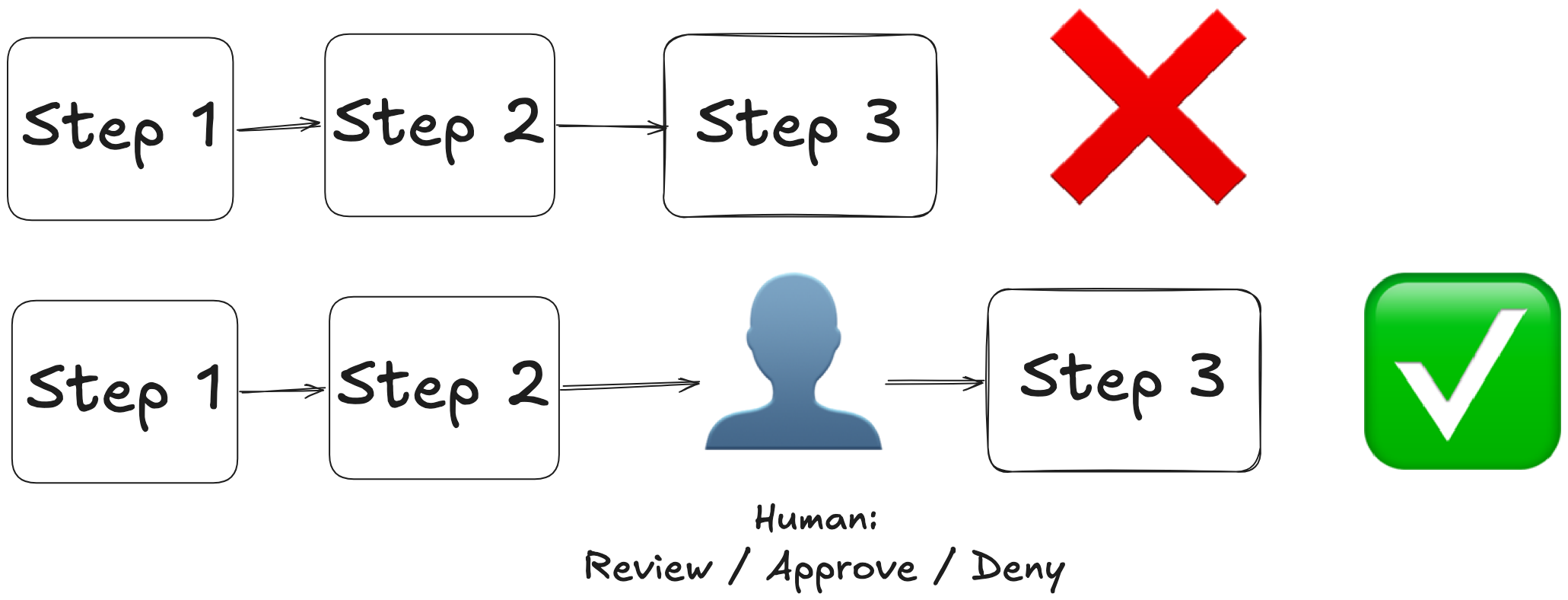
Here's the reality: agents do make mistakes. But with the right setup, those mistakes are predictable, containable, and far less costly than the inefficiencies they replace. The key is knowing where to keep a human in the loop and where to let the agent run.
This isn't a reason to avoid agents. It's a reason to be thoughtful about how you deploy them. The more autonomous the agent, the higher the stakes of each individual decision. That's not a flaw in the technology. It's just the nature of autonomy.
So how do you think about this practically?
Keep a human in the loop for anything irreversible. If the agent is drafting something for a human to review before it goes out, great. If it's taking an action that can't be undone, that's where you want a checkpoint. Same goes for anything with significant consequences: financial, legal, reputational. Early on, before you've had a chance to see how the agent behaves across a range of situations, err on the side of more oversight, not less.
You wouldn't give a new hire the company credit card on day one. The same logic applies here.
The businesses that get the most out of agents aren't the ones who automate everything immediately. They're the ones who move deliberately, build trust over time, and expand autonomy as it's earned.
Hard Limits: What Shelley Simply Cannot Do
There's a difference between telling an agent "be careful with refunds" and making it impossible for the agent to process a refund over $5,000 without approval. One relies on the AI following instructions. The other makes the unsafe action impossible, full stop.
Think of it like a child lock on a car door. You're not relying on good behavior. You're removing the option.
The best-built agents have these hard limits baked in at the system level, completely outside the AI's control. That's what separates a polished, trustworthy production tool from a promising demo that nobody quite trusts enough to use.
Where to Start
Let's make this actionable. Here is a simple 4-step framework to get started today.
Step 1: Find the right process.
Look for something repetitive, well-defined, and lower-stakes. Not your most complex, mission-critical workflow. Something that happens regularly, follows a predictable pattern, and won't cause a disaster if the agent makes a mistake early on. That's your starting point.
Step 2: Document the knowledge behind it.
This is the step most people skip, and it's the one that matters most. Don't assume the agent will figure it out. Write down how the task gets done. What does good look like? What are the edge cases? What would you tell a new hire on their first day? The more clearly you can articulate it, the better your agent will perform.
Step 3: Identify the tools it would need.
What does the agent need access to in order to complete the task? A CRM? A specific web form? A knowledge base? Get specific. A clear picture of the toolset makes the implementation a lot cleaner.
Step 4: Start simple, keep a human in the loop, and expand from there.
Don't try to automate everything at once. Get the narrow version working well, build confidence in it, and grow from there. Autonomy is earned, not assumed.
The businesses that win with AI over the next few years won't necessarily be the ones with access to the best models. The models are becoming a commodity. What will separate the winners is how well they've documented their processes, how clearly they've captured their institutional knowledge, and how thoughtfully they've built their agents.
That's not a technology problem. It's a business problem, one that's about clearly documenting how your business works and finding the right partner to build it properly.
The businesses that figure this out in the next 12 to 18 months will have a meaningful, compounding advantage over those that don't. The window to move early is still open. But it won't be forever.
If you're not sure where to begin, that's exactly what we do at Siah Labs. Reach out and let's talk.